


 -Method
 be an integer that we wish to factor. Choose a positive
integer
be an integer that we wish to factor. Choose a positive
integer  (usually
  in practice). The Pollard
-method hunts for prime divisors
in practice). The Pollard
-method hunts for prime divisors  of such that
  is
-power-smooth. Here is the strategy.
Suppose that
is
-power-smooth. Here is the strategy.
Suppose that  and
and  is an integer that is prime to .
By Fermat's Little Theorem,
is an integer that is prime to .
By Fermat's Little Theorem,
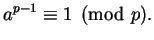 is -power-smooth and let
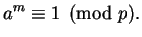
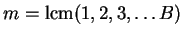 . Then
 , so
, so
 , and so

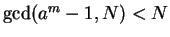 also, and when this is the case
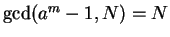
we have split . In the
unlikely case when
also, and when this is the case
we have split . In the
unlikely case when
 , then
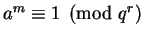 for
every prime power divisor of . In this case, repeat the above
steps but with a smaller choice of (so that
for
every prime power divisor of . In this case, repeat the above
steps but with a smaller choice of (so that  is smaller).
Also, it's a good idea to check from the start whether or
not is not a perfect power
is smaller).
Also, it's a good idea to check from the start whether or
not is not a perfect power  , and if so replace by
  .
.
In practice, we don't know . We choose a , then an  ,
cross our fingers, and proceed. If we split , great!
If not, increase or change and try again.
,
cross our fingers, and proceed. If we split , great!
If not, increase or change and try again.
For fixed , this algorithm works when is divisible by a
prime such that is -power-smooth. How many primes
have the property that is -power-smooth? Is this very
common or not?
Using the above two functions, we find that roughly 15% of
primes between  and
and
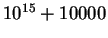 are such that
is
are such that
is  power-smooth.
\\ Count the number of B-power-smooth numbers an interval.
{cnt(B)= s=0;t=0;
   for(p=10^15, 10^15+10000,
      if(isprime(p),
         t++;if(ispowersmooth(p-1,B),s++)
      )
   );
   s/t*1.0
}
? cnt(10^6)
%5 = 0.1482889733840304182509505703
Thus the Pollard -method with  is blind to 85% of the
primes around . There are nontrivial theorems about
densities of power-smooth numbers, but I will not discuss them today.
is blind to 85% of the
primes around . There are nontrivial theorems about
densities of power-smooth numbers, but I will not discuss them today.